 Counted
Anonymous worker voice census
Counted listens to the many.
A worker scans a QR poster on the wall, picks a language, and answers questions mapped to the eleven International Labour Organization (ILO) forced-labour indicators. Eight minutes, no name, no account, and a gift card at the end. What the organisation gets back is a site risk score with the trend over time, and reporting that lines up with the Modern Slavery Act. What it never gets is any way to work out who said what.
The first button opens an email to hello@justsupply.org
- Indicators
- Eleven, from the ILO
- Time to answer
- Eight minutes
- Worker's name
- Never held
- At the end
- A gift card
What it does
What each person gets from Counted.
For the worker
Eight minutes, and you are paid for it
Scan a QR poster, pick a language, answer in about eight minutes. No name, no phone number, no personal detail. Location is checked once to confirm on site presence, then discarded. Finish, and a digital gift card arrives on the device: worker voice is paid for.
For the organisation
A site risk score you can act on
A score broken down across the eleven ILO indicators, red flag alerts on the areas that need attention, and reporting aligned to the Modern Slavery Act. Run as a recurring cycle it shows the trend at a site over time, and compares sites across an operation.
For the steward
A named custodian
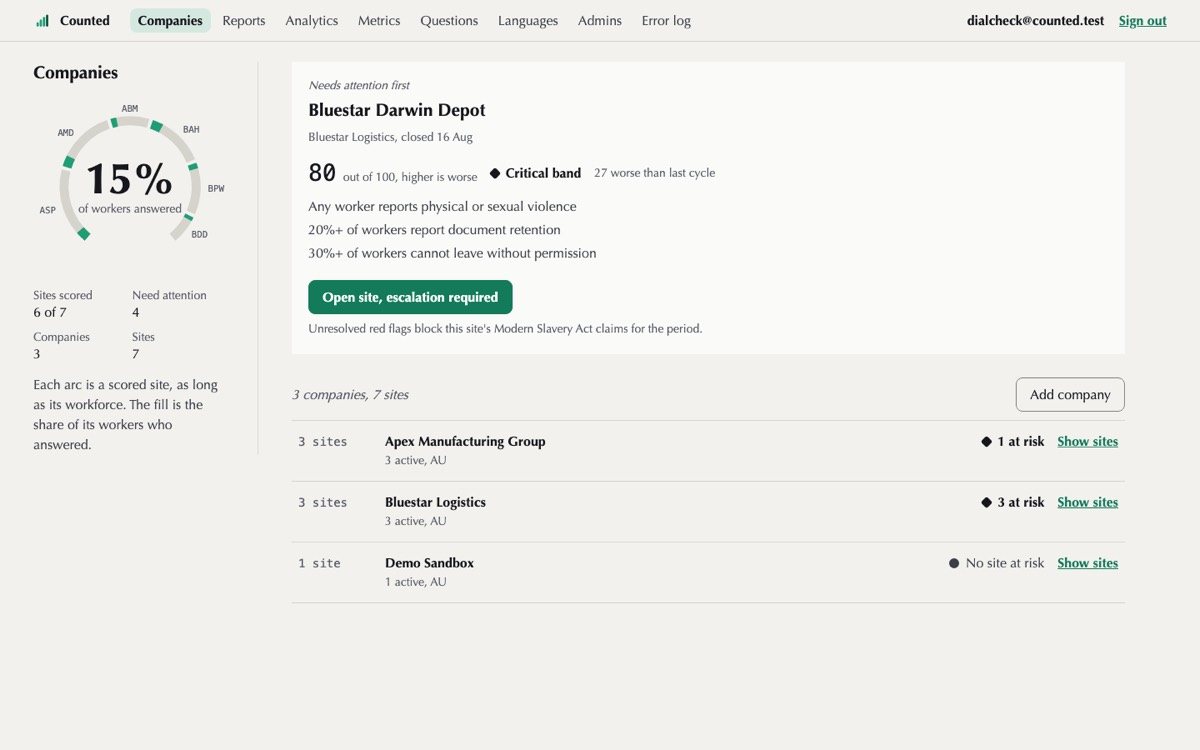
The steward is the person responsible for what workers shared in good faith. A dashboard lets them configure a census, watch how many workers start and finish, verify reward accounting, and read results per site, per cycle, per company. A steward never sees an individual response, and cannot.
A language model drafts each report from the site's own data. The scoring itself is fixed arithmetic, not a model judgement, and a steward reads every report before it is shared.
See it
From the poster to the dashboard.
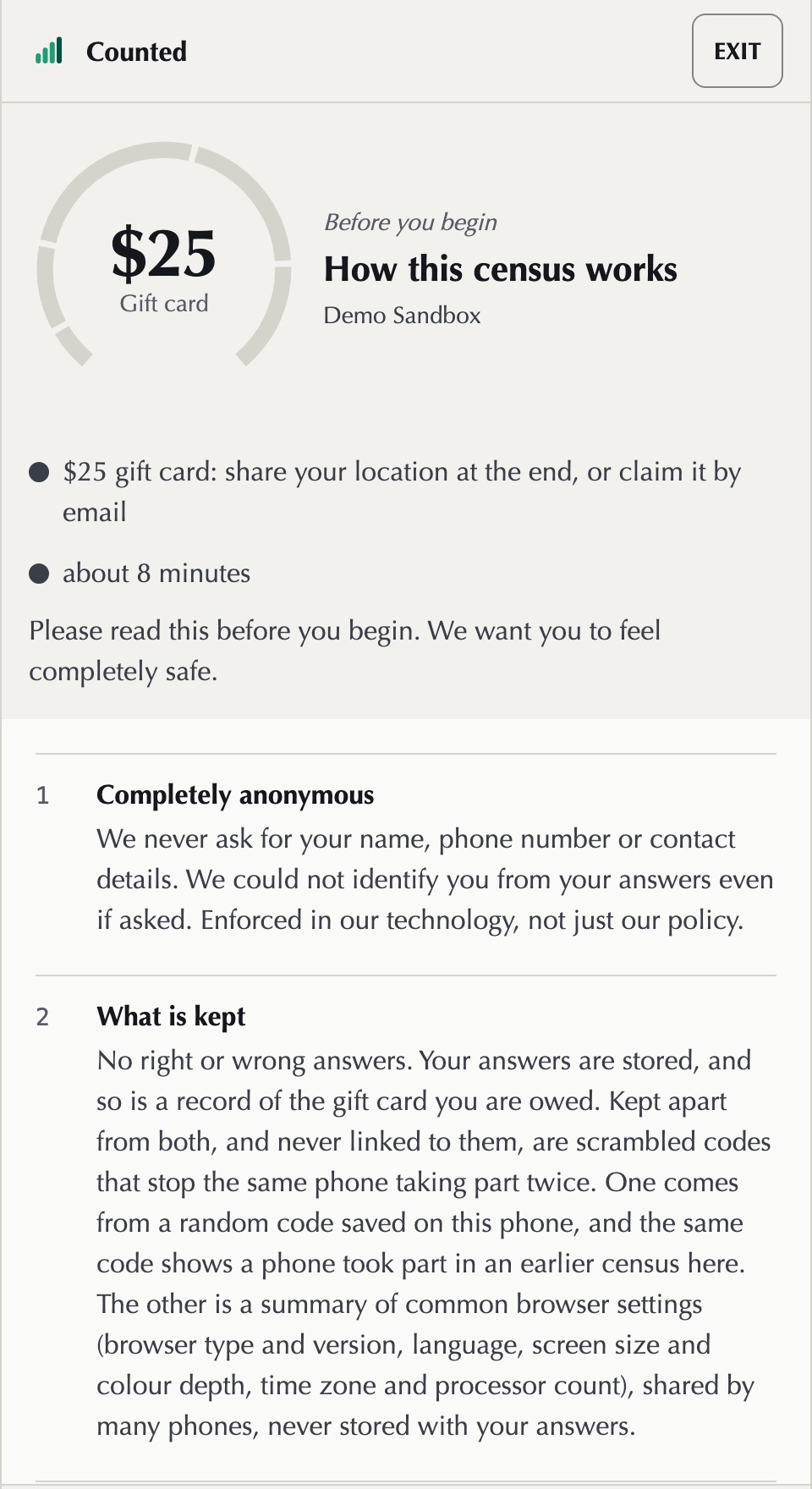
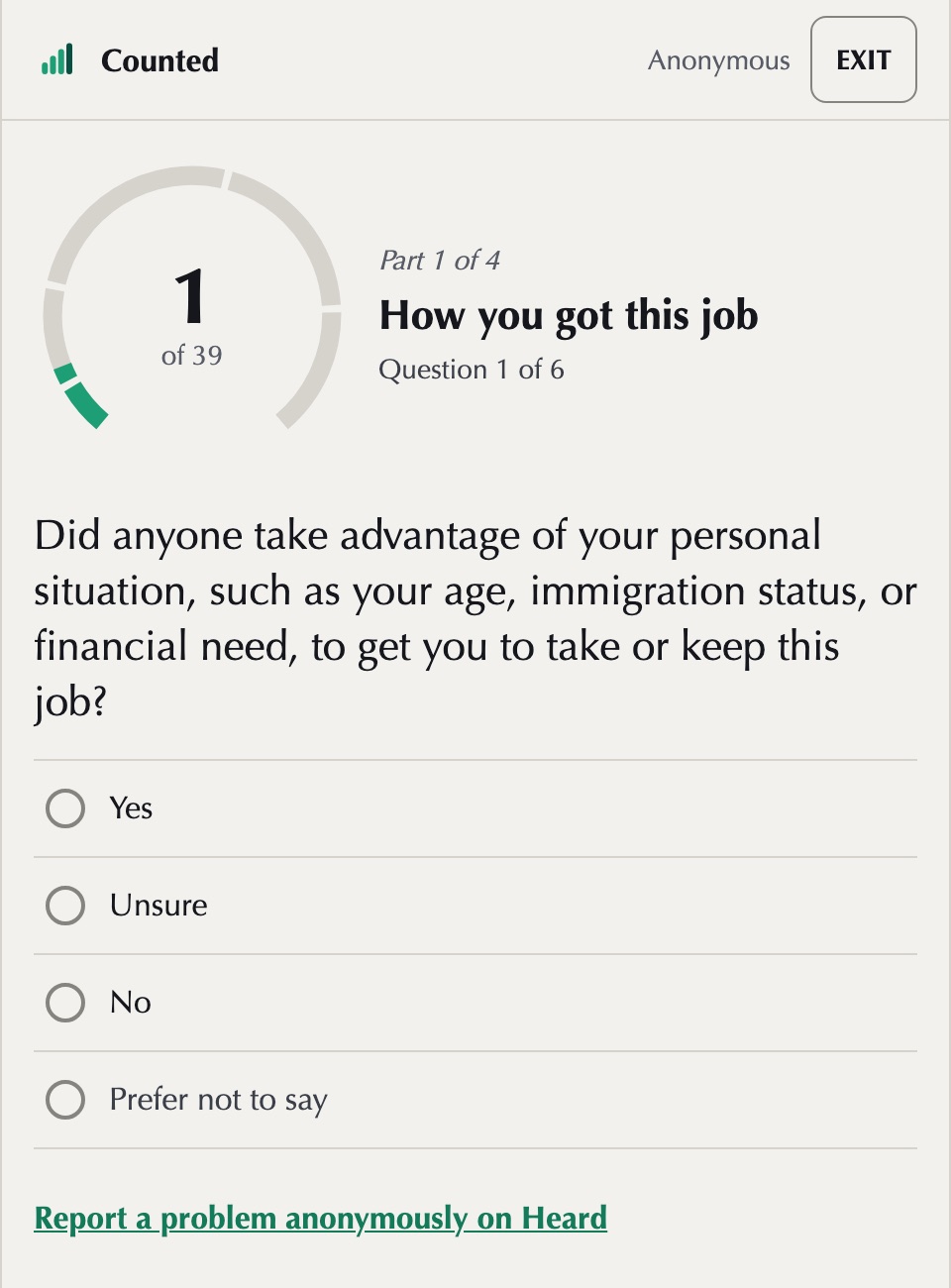
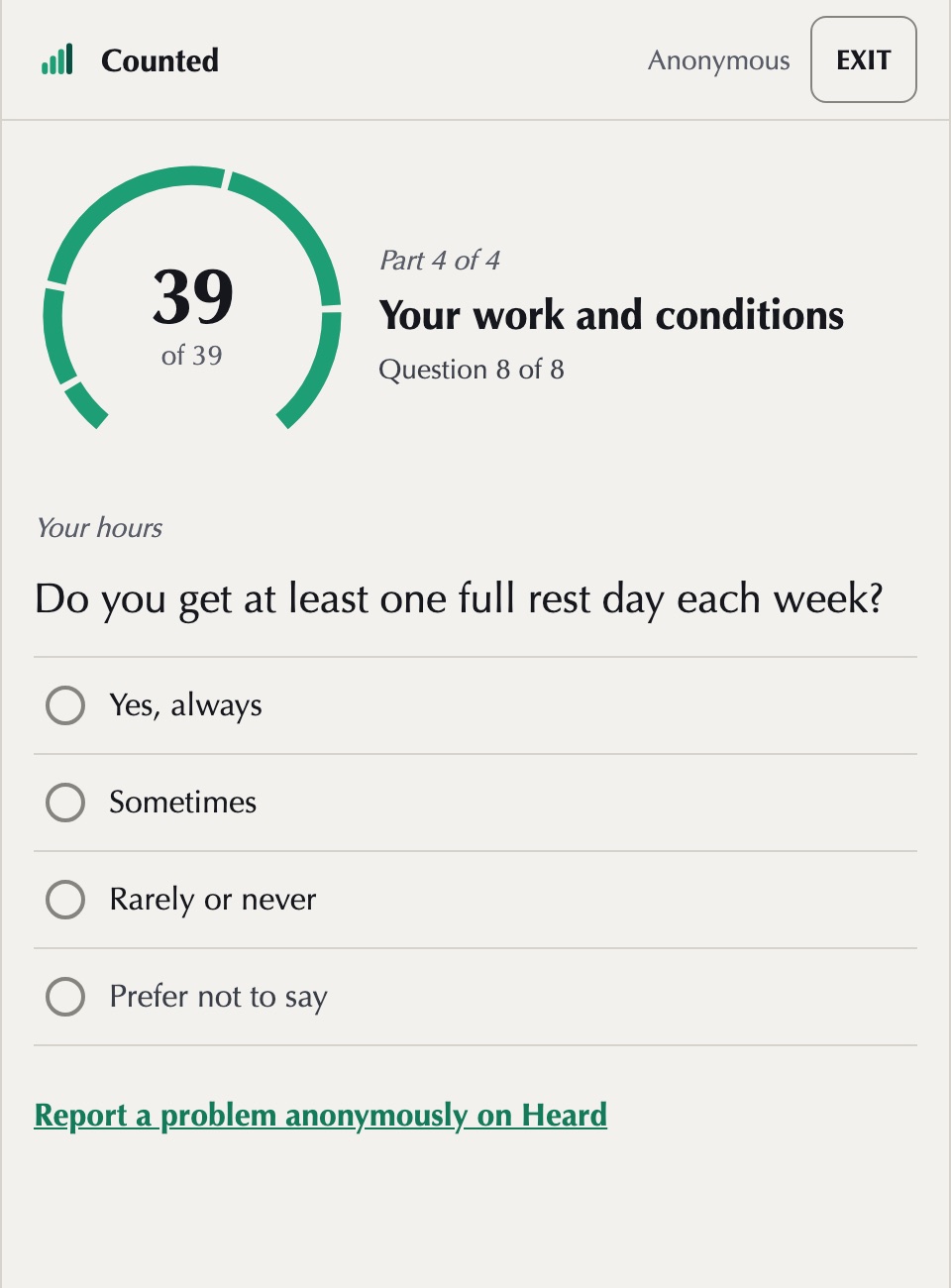
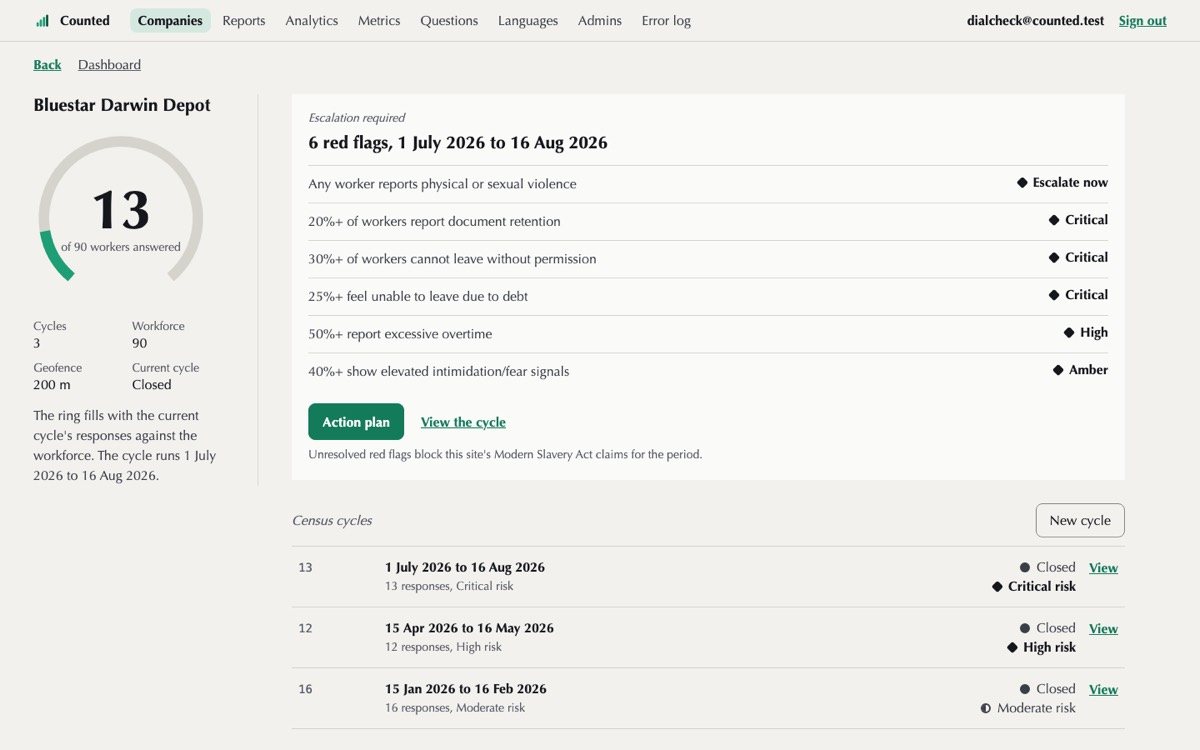
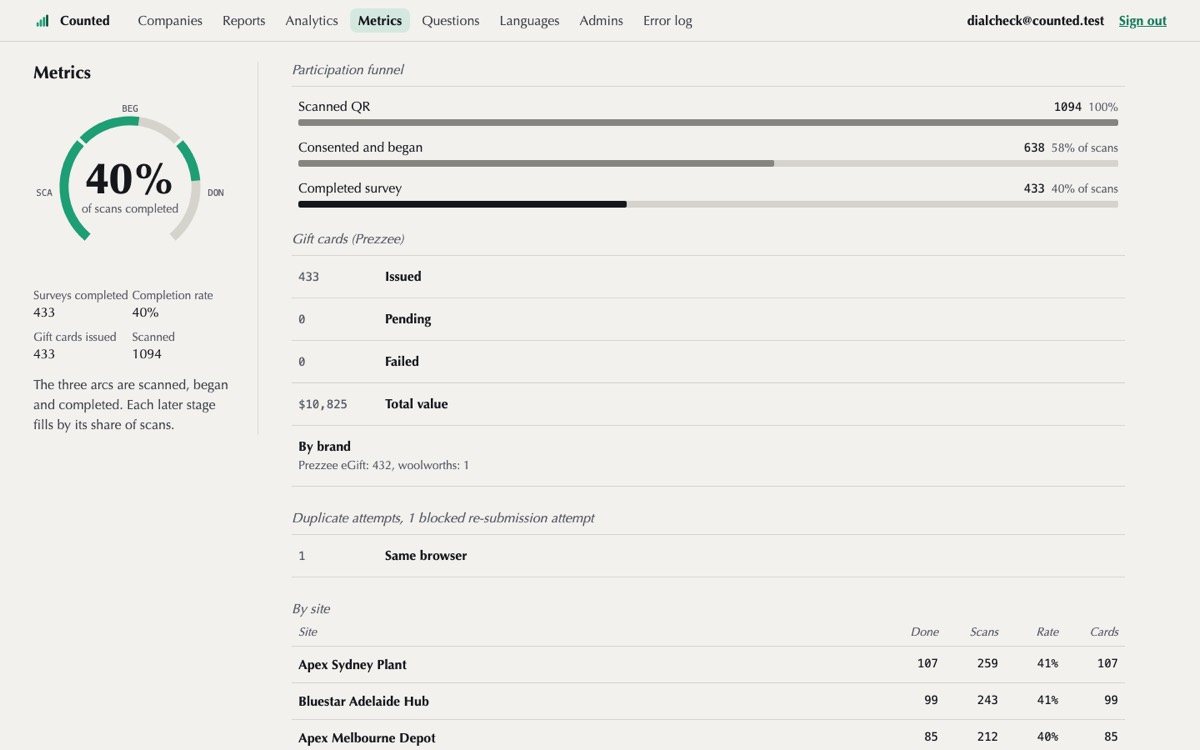
Screens from the running app. Phone screens show the worker census; the rest show the steward dashboard. Demo data.
A critical flag does not wait for the report. The moment one fires, the steward gets the alert in real time, in the channel your team already watches: Slack, Teams, email, SMS, set at setup. They open the dashboard and see what is happening.
The design
Counted never holds a worker's name.
A promise of confidentiality is worth what the worker thinks the employer will do with it. An architecture that never holds the link is worth the same to everyone, including the people most afraid to speak.
- No worker account, no name, no phone number. Responses are not linked to any individual worker.
- GPS is used once to confirm the worker is genuinely on site, then discarded. The check confirms presence and keeps no trail.
- Because Counted is independent of the audit chain, it tests an organisation's assurance. It surfaces what site-visit social audits reach least.
- Heard runs on a completely separate data store. A census answer here can never be cross-referenced against a concern raised there.
The questions
Mapped to the eleven ILO indicators.
Tuned to the specific work context, asked in the worker's own language, and grouped so they read as a conversation rather than a compliance form. The eleven are the ILO's own. ILO source
- Abuse of vulnerability
- Deception
- Restriction of movement
- Isolation
- Physical and sexual violence
- Intimidation and threats
- Retention of identity documents
- Withholding of wages
- Debt bondage
- Abusive working and living conditions
- Excessive overtime
Reading the results
Reading a Counted report.
Counted reaches as far as the poster does
Nobody has to be on a list, so the system never sees who employs a worker. A booked audit visit meets the people it is introduced to; the poster meets whoever walks past it.
A low response rate is itself a finding
You tell us how many workers each site has, and the census reports against that number. A site expecting 400 workers that returns 30 answers is telling you something useful on day one, usually about how the census was rolled out there: where the poster went up, which shifts walked past it, who had a phone to hand. The steward sees that site by site, and it is often the first thing worth acting on.
For workers
Looking for the survey?
Find the Counted poster at your workplace and scan its QR code with your phone camera. The poster is the only way in, and that is what keeps your answers unlinked to you. You give no name, phone number or account. Every screen of the app has a Quick exit button.
Where it fits
Counted on its own, and as one of four records.
Counted is built and deployable in its own right. It runs on its own, and it works the same way in any industry: a mining company, a transport authority, a food processor, a construction principal, a facilities contractor, a grower, anyone with a workforce or a supply chain to protect.
It is sold alongside its sibling Heard, and the two divide the work cleanly: the census surfaces the pattern, the grievance channel handles the individual case. Within the wider Just Supply platform, Counted supplies what workers say, first hand, to the assessment engine.
 HeardThe sibling product. An anonymous grievance channel that takes one worker's concern through to a tracked resolution.
See Heard
 DeclaredThe company's account of itself, checked against the documents behind it. Proof reads it beside the workers' census.
See Declared
 Just SupplyThe wider platform: a payment rail for supply chains, goods or labour, owned by the people in them, where the Index sets what each company pays.
The whole idea
What to know before you deploy it
- Reach follows the poster, not a payroll list. Anyone standing on the site can answer: direct employees, labour-hire crews, seasonal and migrant workers, people taken on for the day. There is no list to be on, which is how the census reaches people a booked audit visit never meets.
- Workers recruit workers. Peer referral is in build: a worker who has taken part gets their own code to pass on, and a reward that grows with the number of workmates who use it. That gives the people already inside a workplace a stake in extending the reach, which gets to workers a poster on a wall never will. The invite carries the workplace and never the worker, so the two are never linked.
- What it misses is work that never passes a poster. Off site work, or a site with no census running. Where the posters go and how many cycles you run answers most of it.
- Counted makes the problem visible. That is the first step, because nothing gets fixed while it stays invisible, and it delivers most where leadership is ready to act on what comes back.